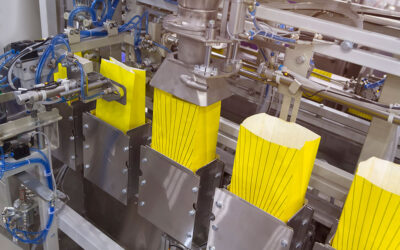
Chuck cappers can be rotary or inline, continuous or intermittent motion. They can run at speeds from 20ppm to 1200ppm or more. What they all have in common is that they use a female chuck to engage the male cap and turn it down to a precise application torque.
The first thing to understand is that the end user is only interested in removal torque, sometimes called “off torque.” Too much removal torque and they will not be able to get the cap open. Too little and it will leak. Big leaks will make a mess. Small leaks, even if no product escapes, may allow air to get in and spoil the product.
The goal of the packaging is to make sure that every bottle has the appropriate removal, sometimes called “off torque.”
This is a problem. The capping machine can only control application torque or “on torque.” There is a relation between the two but it is not 1:1. An application torque of 10 inch-pounds might give a removal torque of 14 inch-pounds. Or, an on torque of 14 inch pounds may give an off torque of 10 inch pounds.
Capping machines have a lot of components but the two most key to consistent on and off torques are the chucks and clutches.
Chucks must grip the cap positively without slipping and the clutch must slip or release cleanly when the proper on torque is achieved.
Clutches are mechanical devices designed to slip or release when torque reaches the target set point. In this discussion, we will take a bit broader view and include other devices that are used to control the capper application torque.
Download the complete Chucks and Clutches White paper to continue learning about cappers.