Tag: Shared Assets

Get to a Place Where You Can See Something

In episodes of Dual Survivor, the hosts of the show often speak of “getting to a place where you can see something.”

In the case of this Discover Channel reality series – this means getting to a place where you can see your way out (of the jungle, desert, etc.) in order to survive.

Surviving in the CPG space also means getting to a place where you can see something – results, increased revenue, what works, and what doesn’t.

Instead of climbing a tree or mountain, brand owners navigate the supply chain to release new products and packages into the marketplace.

New ideas for packaging, new product ingredients, or completely new products get into a queue.

However, these new ideas negligibly or worse yet negatively impact revenue while incurring costs with no production or sales.

Until launched in the market, these are a cost burden.

Quickly moving to a point where you can see favorable ROI is the goal.

Frain Integration specializes in getting brand owners to the market faster with more ideas with less committed capital per project.

Most importantly, our advanced approach captures revenue, previously not captured, through expedited packaging equipment delivery from our vast inventory, expertise, and manpower.

Brand owners diversify project initiatives by allocating funds towards more projects via equipment rental and leasing terms, quickly cutting off losers and dialing up production on winners.

Frain Integration has worked with numerous Fortune 100 companies to integrate completely new product packaging lines to market several months sooner than traditional methods.

Within this interim, the brands we’ve worked with have increased their capacity to find new winning combinations of packaging and product mix, while most importantly securing millions more in previously uncapitalized revenue based on timing constraints of traditional approaches.

Not every project is a winner.

But, surviving in today’s quickly evolving marketplace takes a competitive advantage of finding ways to test new ideas quickly and gain a vantage point over your competition.

Let us help you get to higher ground.
CPG Data Proliferation

I’ll be the first to admit that I often shop with my head in my phone – mostly because I shop with a list that’s already on my phone, but also because I can Google items if impulsively purchasing to see product reviews, or check various price offers for larger, non-impulsive purchases.

If shopping online, though, I’ll expect that this information already exists on the site to help with my purchasing decision.  That’s exactly what data companies in the CPG Industry are adding to internet retail, eCommerce, mobile marketplaces and real-time, omnichannel shopping destinations.

Forrester’s most recent eCommerce forecast estimates online retail sales to exceed $500 billion by 2020, up from $373 billion in 2016.

With real-time, shopping data pulled and pushed across the internet, the recycling of information in the CPG space is snowballing.

The CPG Industry has long relied on retrieving sales data directly from retailers like Walmart or indirectly thru syndicated market data providers like Nielsen.

As CPG companies begin to focus more on e-commerce and dealing with online retailers due to shifting consumer shopping trends, more and more data is beginning to fill this expanding pipeline.

New apps and companies are emerging to facilitate online and offline purchase data exchanges.  Data originates from receipt scanning apps like Receipt Hog or Ibotta and e-commerce services like Slice, where you can track all of your packages, purchases, price drops, and product recall info in one place.

ItemMaster, a spinoff of Peapod.com, recently struck a deal with Walmart.com to deliver certified brand content and IM content along with the shopping experiences for one of the largest eCommerce platforms in the World.

Apps and data services like this will not only help consumers to get a better handle on purchases but ultimately businesses to get a better handle on consumer demand and trends in real time.

You’re Only Getting Half of the Pie


… And it’s often already stale.

Such is the case with project revenue in today’s new CPG product and packaging space.

With decisions to be made and Gantt Chart lines to come to fruition, including purchasing your new packaging machinery, you’re likely realizing only half of the year-one revenue in your forecast.

As with anything else, people become set in their ways and used to doing things the way they’ve always been done.  However, some with the right ideas, timing, and execution – can get to market quickly and capitalize with non-traditional approaches.

After working with many larger CPG brands on complete packaging lines, Frain discovered opportunities to work on a complimentary basis with new packaging equipment.  We didn’t ask brands to stop what they were doing, but instead asked them to consider capturing additional revenue that they wouldn’t otherwise realize.

Numerous times since then, Frain has complimented traditional wholesale brand revenue and standard project deployment with our rapid deployment and incremental revenue through expedited speed to market.

You could say we’re helping our customers get to the pie before anyone else, while it’s fresh.


Speed to Market Revenue

In a previous job for a fortune 500 corporation, a business partner of mine said to me, “You are an ocean liner in a bay and we’re your speed boat.”

Conceptually, his statement punctuated our symbiotic relationship whereby his company seized opportunities on behalf of my company for which they were better suited given their smaller, more nimble make up.

Like the best and largest cruise ship’s inability to port at smaller islands – many CPG companies are also unable to expedite smaller jobs, such as introducing new products or packaging redesigns.  Getting to market just a few weeks slower can add up to millions of incremental revenue left on the table to competition.

Partnerships can help CPG companies seize the day.  Agencies, consultants, and other companies within the supply chain can help circumnavigate obstacles that would otherwise impede progress, complimentary ideas, people, services, and efficiency which translate into greater revenue and market share.

At Frain, we’ve found success in partnering with customers to help them deliver new or redesigned products to market faster.  Our rapidly deployed machinery enables our customers to maximize short-term revenue through lead times that are faster than traditional equipment OEMs, while limiting risk and investment through borrowed machinery.

Whether the project fails or succeeds to gain traction within the marketplace, our customers succeed (and fail) faster and have the flexibility to return equipment or keep it as needed.

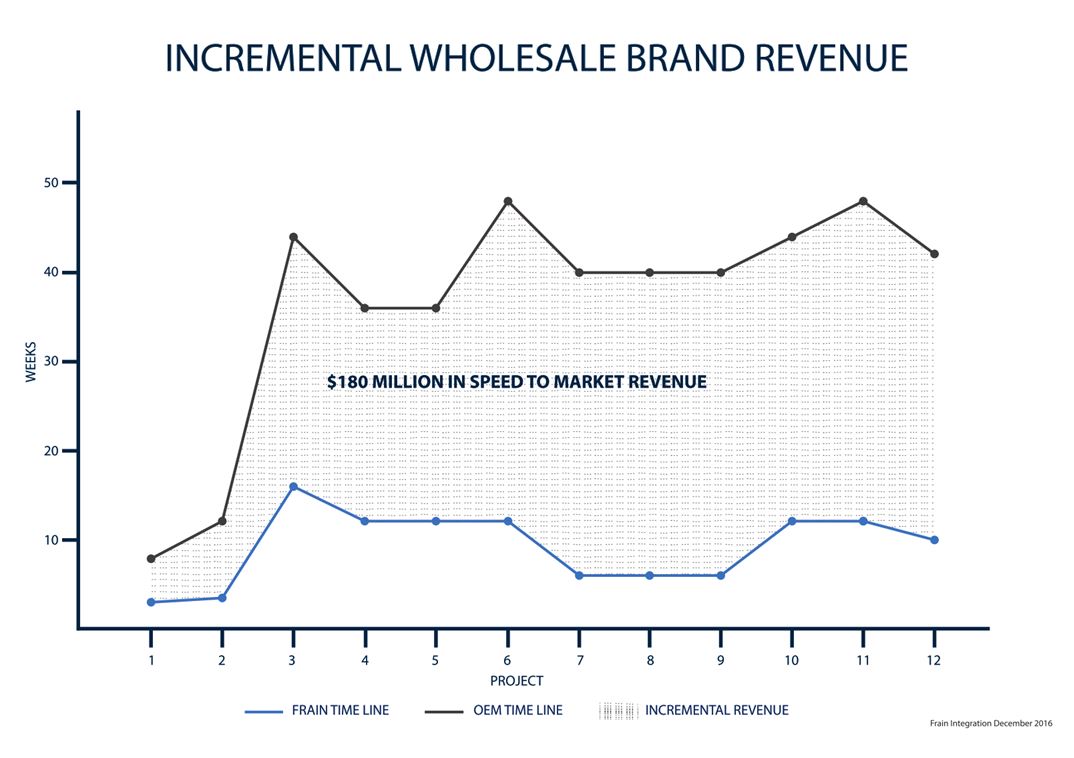
For example, when equipment lead time of 3 months is shortened to 2 weeks with Frain – our customers gain 10 weeks of revenue not gained in traditional machinery integrations or deployments.  For our customers this can yield anywhere from $5 MM to $100 MM more in incremental wholesale brand revenue depending on margins.

While the path to improving speed to market may be complex and multi-faceted for many companies, Frain provides a streamlined service within a key point of the supply chain – packaging machinery.

The chart below represents total speed to market revenue (approximately $180 MM) captured by eight Frain customers across twelve projects or deployments.


frain-speed-to-market-brand-revenue


Top 10 key takeaways from the Uber Revolution Pack Summit

Frain Integration, in partnership with the Contract Packaging Association (CPA) and other industry leaders, was proud to host the Uber Revolution Pack Summit – Tuesday, September 20 – 21, 2016.  Below are some testimonials from this summit, followed by key takeaways.

“Loved Ron’s presentation, and the supplier panel was also very good.”

“It was well done and I’m thankful to be invited.”

“This event was well thought out and presented.”

Here are ten important takeaways from this summit.

  1. Data

Jason Tham, CEO of Nulogy Corporation stated that, “It does not matter what you build. It is what you have access to.” Millennials, in particular, have immediate global communication research influence, and real-time data at their fingertips. This instant access to information, feedback, influence, but most importantly data – pushes agility, decisions, and market trends.

  1. Speed/Agility

According to Business Insider, 40% of millennial consumers turn to on-the-go breakfast options to minimize clean-up time. Having breakfast options when and where it’s needed is not only convenient, but often faster. Likewise, speed and agility are becoming top priorities within the supply chain.  Suppliers and brands are collaborating via shorter runs, data sharing, and speed to market incentives.

  1. Shared Assets

A shift is taking place whereas temporary, short-term assets are superior to fixed assets. Vacation rentals and taxi fleets, for instance, are not centrally provided in the shared model, but instead nimbly deployed as needed.   Shared manufacturing and access are also emerging and offering the same efficiency within the Packaging Industry today.

  1. Collaboration

Depending on the level of collaboration, brands must be flexible. They leverage each other’s data, logistic resources, and distribution centers. Still, brands have to consider how collaboration impacts intellectual property (IP). Geographically, certain cultures may make it difficult due to replication and speed, while suppliers may make it challenging due to knowledge access.

  1. Flavor Explosion

Keeping up with flavor explosion has proven to be a challenging opportunity for brands.  New demand aims for solutions where brands understand that selling existing products is not an alternative. Rather these temporary solutions are primarily driven by data, information, and agility. An interest in organic baby food, as an illustration, drew a need and preference that established a new price point for apple sauce.

  1. Packaging and Size Portion

Sustainability and health concerns have pushed for a less is more movement. Wasteful and non-recyclable packaging has transformed to new, smaller, and/or prudent packaging. Take for example, Libby’s Sweet Corn went from a 16 oz. can to a 14 oz. stand up pouch without changing the price- $1.19.

  1. Commerce

E-commerce has competed with traditional commerce for several years, but is it possible that retail shelf space will decline due to the on-line channel? Communication between brands, suppliers, and retailers is the essential to the off-line market while real time data is key to an online channel.    There is an extremely profitable future in e-commerce and many companies, like Clorox, are trending to this space, and investigating how to best supply product to this network.

  1. Technology

Todd Caraway, Director of Contract Manufacturing of Continental Mills, Inc. stated that, “Technology continuously increases in impact.” Mike Brodie, Director of Contract Manufacturing Partnerships of Torani agreed to, “Invest in data and make decisions upon that data.”

  1. Mass Individualization

Long gone is yesterday where uniformity and similarity was the mass customization of a group. Today individual needs are calibrated for a mass customization of an individual with an explosion of private label competition versus big brands.

  1. Transparency

Now, more than ever, consumers want to know what they are consuming and where it came from. The ultimate goal is complete product transparency and brands need to collide with the supply chain to achieve it. Through transparency companies create brand loyalty and establish differentiation among competitors.