Tag: Transparency

The Social Push

With a tremendous rise in social media, companies, sectors, groups, individuals, etc. have been “exposed”.  Customers are not only expressing their likes/dislikes to the manufacturer. They are using public displays and online interaction to express concern, dejection, amazement or favoritism toward a brand, product, person and everything in between.

For example, a loyal customer shared her disgust of a cosmetic product over social media and even directly to the founder of the company: “So,,, I hit pan on my @JeffreeStar highlight and found HAIR embedded into it.” Another shared disbelief and difficulty supporting a product: “Your beef is frozen and we all know it. Y’all know we laugh at your slogan ‘fresh, never frozen’ right? Like you’re really a joke.”

As a result to public complaints, many companies have directly pushed for transparency and optimization of quality to improve their products.

Some companies turned to Frain for the automation of their production lines by using robots, detection technology or equipment that decreased the number of operators to reduce human error. Customers selected from a wide variety of packaging and processing equipment to convert to a semi-automatic or automatic process to enrich production lines and quality control.

Whether you prefer data collection/analyzation or a combination of both automation and data, Frain has the equipment needed for a seamless transition. Our technicians, mechanics, and engineers are dedicated to your equipment goals and integration requirements.

Let Frain help you like it has helped other companies.

Front Line of Decision Making

Shoppers may have a list in mind when heading to the store, but research suggests that approximately 82% of in-store purchasing decisions are made at the actual point of purchase when the consumer does not specifically have a preset brand in mind.

With an undecided consumer standing front of your product, your packaging needs to stand out.  Here are six considerations to make in standing out from your competition:

Sustainable

According to Mintel’s 2017 Global Packaging Trends Report, 21% of Canadian consumers are interested in a resealable or re-closeable packaging in order to reduce waste – in addition to delivering on known consumer desire for portion control.

Usable

Innovating and testing new packaging formats that stand out from the competition can include the way you make it easier or more convenient to consume.  Squeezable sour creams and apple sauces revolutionized the ease of use of their product taking them from traditional packages that relied on spooning out the product to squeezable formats which could be simply used by anyone.  By bucking the trend alone, you will stand out on the shelf and create space between you and your competition.

Transparent

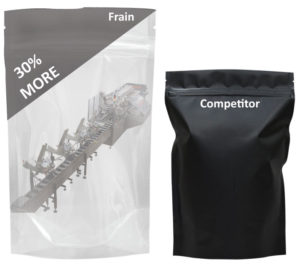
Sometimes being different is as simple as being clear with your packaging and labeling.  By clearly showing what’s inside your package, you gain trust and purchases with consumers. People are more interested in what’s in their food, how it’s made and from where the ingredients originate.  Sometimes less noise in packaging is more.  And, what can be more simple then clear packaging?

Refreshed Look

Speaking of less is more, it’s been proven time and again that packaging can outmatch quantity for the same price.  For example, Libby’s refreshed their sweet corn packaging with a new flexible stand-up pouch and line priced it against their can package.  While both were available at $1.19, the new stand-up pouch offered two ounces less product, but still outperformed the canned corn.

Premium Feel

Appealing to the consumer’s senses goes beyond taste and sight.  Aloha bars are a great example of a product with a branded sense of touch or premium feel.  From the box to the actual individually-wrapped protein bars and powder pack, you get a high-touch premium feel to this vegan-friendly product for which consumers are paying extra.

Eye Catching

Shoppers are in a hurry, but once they find the section of ketchup, soft drinks, etc. that they’re looking for – you may have a fraction of their tunneled, peripheral vision whereby you need to catch their attention.  Aside from shape, message, new packaging and feel – you may also throw in an eye-catching element within your packaging, much like Tito’s Handmade Vodka and its copper cap.

Transparency and Eco-Friendly Trends Continue

As pointed out in PackWorld’s article, Four Key Beverage Industry Trends in 2017, millennials continue to purchase beverages based on:

  1. Influences, such as eco-friendliness, less processed foods, less ingredients
  2. Clean and clear packaging
  3. Health –  fresh and eco-friendly
  4. Multifunction: refreshment, health, satiety, energy, immunity boosting, and sleep aid

While the environment continues to grow in influence for consumers – we support this focus.  Here’s our quick take on how you can add an eco-friendly component to your supply chain with Frain:

Certified Pre-Owned

80% of CPG projects fail.  Many times, equipment goes completely unused or barely used.  This creates an opportunity for you to find the machinery you need already existing in Frain’s recycled, second hand equipment inventory.

Much like purchasing a BMW that has 1,000 miles on it, many of the equipment we store is like new and from highly trusted manufacturers.  However, before any of it ships – we completely address every machine pneumatically, electrically, mechanically and cosmetically to make them certified pre-owned, backed by our guarantee and a 6 months parts warranty.

Parts Inventory

While we do not sell parts, we keep 150,000 square feet of parts inventory on hand to keep the machines, that we sell, running.  This ensures the maximum uptime and lifespan of our machines, keeping them out of landfills.

433 Tons of Greenhouse 

Re-purposing Frain’s equipment back into the work place or through shared access of machinery, saves approximately 686,000 pounds of new machinery, and 433 tons of greenhouse emissions per year. Our climate controlled warehouse further increases the re-purposing life span, and the quality of equipment we introduce to our clients.

There are many options in the market for packaging and processing machinery.  Over more than 35 years, Frain has established itself as an equipment provider that not only allows companies to capitalize on the environmentally-conscience aspects of used machinery, but also the speed, revenue generating and cost savings aspects that certified pre-owned machinery yields.

While being hyper transparent ourselves with our customers by fully disclosing the detailed service we provide and inviting anyone to visit our facilities to tour Frain, we also offer an eco-friendly approach to packaging machinery.

We’re a critical mass of equipment inventory, engineering expertise, and technician manpower to help you get the most from your next project.  We look forward to working with you in 2017.

Frain Package

With consumers demanding transparency from items like food to processes like cultivation, it is important for companies to let their customers know exactly what they are getting. Our team of engineers, technicians, and account managers at Frain is very clear about what comes with each machine purchase, rental or lease.

We stepped away from As-Is equipment to fulfill the demand gap that the packaging and processing industry faced for years: working equipment for exact applications. And we did so by ensuring that from the moment our customer contacts us, we provide extensive equipment availability and knowledge. Unlike our competitors, each of our machines comes fully equipped with:

  • In-house partsFrain-Package
  • Complete refurbishment
  • Single item and line integration
  • Dedicated technicians and engineers
  • Shorter lead time (months sooner)
  • Factory Acceptance Test (FAT) / Visit
  • 2-week right of return
  • 6-month warranty on all replaced parts
  • Faster brand revenue

With other used or As-Is, equipment suppliers, customers do not know what they are getting in return for their payment. Many times, customers end up buying the wrong machine, a non-operational machine, or an international unit that turns out to be a short-term venture.

As with any small or large purchases, consumers must be aware of what they are receiving. Demand to know the value and complete transparency behind the purchase.

Next time you make a purchase ask yourself: “Do I know what I am getting?”

Top 10 key takeaways from the Uber Revolution Pack Summit

Frain Integration, in partnership with the Contract Packaging Association (CPA) and other industry leaders, was proud to host the Uber Revolution Pack Summit – Tuesday, September 20 – 21, 2016.  Below are some testimonials from this summit, followed by key takeaways.

“Loved Ron’s presentation, and the supplier panel was also very good.”

“It was well done and I’m thankful to be invited.”

“This event was well thought out and presented.”

Here are ten important takeaways from this summit.

  1. Data

Jason Tham, CEO of Nulogy Corporation stated that, “It does not matter what you build. It is what you have access to.” Millennials, in particular, have immediate global communication research influence, and real-time data at their fingertips. This instant access to information, feedback, influence, but most importantly data – pushes agility, decisions, and market trends.

  1. Speed/Agility

According to Business Insider, 40% of millennial consumers turn to on-the-go breakfast options to minimize clean-up time. Having breakfast options when and where it’s needed is not only convenient, but often faster. Likewise, speed and agility are becoming top priorities within the supply chain.  Suppliers and brands are collaborating via shorter runs, data sharing, and speed to market incentives.

  1. Shared Assets

A shift is taking place whereas temporary, short-term assets are superior to fixed assets. Vacation rentals and taxi fleets, for instance, are not centrally provided in the shared model, but instead nimbly deployed as needed.   Shared manufacturing and access are also emerging and offering the same efficiency within the Packaging Industry today.

  1. Collaboration

Depending on the level of collaboration, brands must be flexible. They leverage each other’s data, logistic resources, and distribution centers. Still, brands have to consider how collaboration impacts intellectual property (IP). Geographically, certain cultures may make it difficult due to replication and speed, while suppliers may make it challenging due to knowledge access.

  1. Flavor Explosion

Keeping up with flavor explosion has proven to be a challenging opportunity for brands.  New demand aims for solutions where brands understand that selling existing products is not an alternative. Rather these temporary solutions are primarily driven by data, information, and agility. An interest in organic baby food, as an illustration, drew a need and preference that established a new price point for apple sauce.

  1. Packaging and Size Portion

Sustainability and health concerns have pushed for a less is more movement. Wasteful and non-recyclable packaging has transformed to new, smaller, and/or prudent packaging. Take for example, Libby’s Sweet Corn went from a 16 oz. can to a 14 oz. stand up pouch without changing the price- $1.19.

  1. Commerce

E-commerce has competed with traditional commerce for several years, but is it possible that retail shelf space will decline due to the on-line channel? Communication between brands, suppliers, and retailers is the essential to the off-line market while real time data is key to an online channel.    There is an extremely profitable future in e-commerce and many companies, like Clorox, are trending to this space, and investigating how to best supply product to this network.

  1. Technology

Todd Caraway, Director of Contract Manufacturing of Continental Mills, Inc. stated that, “Technology continuously increases in impact.” Mike Brodie, Director of Contract Manufacturing Partnerships of Torani agreed to, “Invest in data and make decisions upon that data.”

  1. Mass Individualization

Long gone is yesterday where uniformity and similarity was the mass customization of a group. Today individual needs are calibrated for a mass customization of an individual with an explosion of private label competition versus big brands.

  1. Transparency

Now, more than ever, consumers want to know what they are consuming and where it came from. The ultimate goal is complete product transparency and brands need to collide with the supply chain to achieve it. Through transparency companies create brand loyalty and establish differentiation among competitors.