Tag: time

The Growing Element

In our recent Third Quarter Customer Survey we discovered that 64% of all respondents rate time as the top priority for choosing Frain. They also identified several growing trends, such as equipment automation, flexibility, sustainability, lead time, and a growing market. The respondents appreciate the trends above differently, but lead to an interesting phenomenon: they classify specific growing trends that, in fact, describe what Frain does.

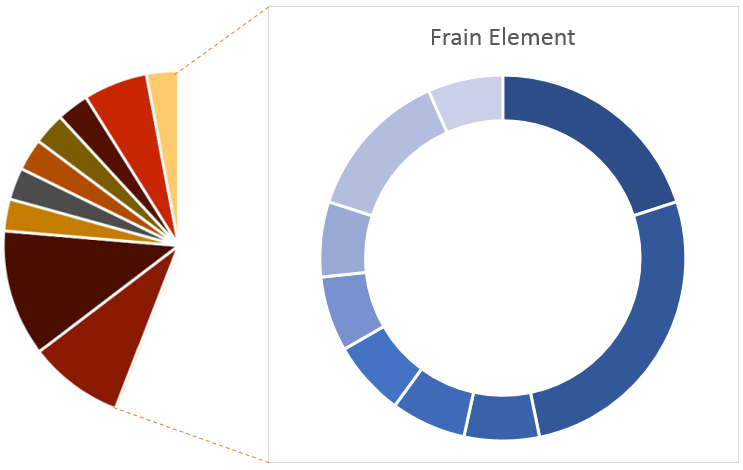
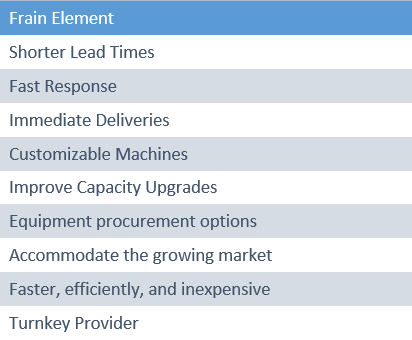
40% of all respondents see a growing trend in what has been identified as the Frain Element. This element consists of 9 factors that shape the way the companies, vendors, and partners interact and respond to consumer demand.
 

Graph Table


Time and speed play a dynamic role in the factors with an inclination toward a faster response at 28.6% and shorter lead time at 21.4%. Our customers appreciate the importance of not only shorter lead times, but also being able to customize machines to accommodate a growing market and the demand for immediate delivery.

Frain has instinctively stayed ahead of the competition by understanding what customers want and providing those services via the largest equipment inventory, faster equipment delivery, and unmatched man power. The Frain Element is the largest and most important trend that customers view as a game changer. We are machine enthusiasts and take pride in providing the right equipment faster than anyone else in the industry.

Read the complete Third Quarter Customer Survey Report for more details on growing trends.

Time versus Money: This is what they said

As part of a 3rd Quarter Survey, Frain asked customers and prospects what mattered most to them when considering an equipment purchase.  Not surprising to us, the two groups differed in their responses.

Frain customers chose time as the #1 influencer in choosing equipment based on 64% response rate.  Quite differently, the larger population of potential Frain customers or prospects choose price as the #1 motivator in choosing equipment based on a 72% response rate.

The tug of war in the packaging and processing equipment space hinges between the expense of time and the initial price someone is willing to pay.

Understanding the importance of time and acknowledging the role Frain plays in closely following project lead time is an expense that Frain helps offset.  As they say: time is money, and our customers appreciate this reality. In the end, the price many pay is downtime, market share, decreased productivity, loss of revenue, and more.

With more customers acknowledging the benefit of time, turnkey providers like Frain can offer a unique service(s) that is customizable at a “mass produced” speed. Customer insight gives us an opportunity to recreate, adjust, or improve existing processes, and implement new ones as required, and it lets us know that time wins every time.

Read the complete Third Quarter Customer Report and Third Quarter Prospect Report for more insights.

Related:

Consumer demand pushes for shorter time frames and faster response.  The Frain Element responds to this demand by enabling it’s customers with the flexibility to customized equipment that accommodates a growing and ever-changing market. Moreover, customers recognize that Frain does a great job at identifying customer needs, responding to their queries, and meeting customer’s deadlines.

Little Things

UTSNXEYBGR

I am rereading Henry Ford’s 1923 book “My Life and Work”. The best book ever written, in my opinion, on the Toyota Production System (TPS). Yes, TPS. Everything that Toyota does as part of their famous manufacturing philosophy was already being practiced by Henry Ford 100 years ago. Just in time, kanban, kaizen, fanaticism about quality, relentless war on waste and more. If you have not read the book, you need to. Drop a note to johnhenry@changeover.com and I’ll send you a PDF copy. Or you can download it as a free audio book.

Something that caught my eye this time through was this:

“Save ten steps a day for each of twelve thousand employees and you will have saved fifty miles of wasted motion and misspent energy.”

If you’ve read my writing before, you know that I am a bit fanatic about how even small improvements have huge results. Reduce line downtime by 10 minutes a day and you gain a week of additional production. I’ve thought about wasted walking but this sentence really brought it home to me.

At first glance, 10 extra steps per day seems like nothing. Over the course of a year, for one person, it is about 11 miles. What value is being added in those 11 miles? Generally none at all.

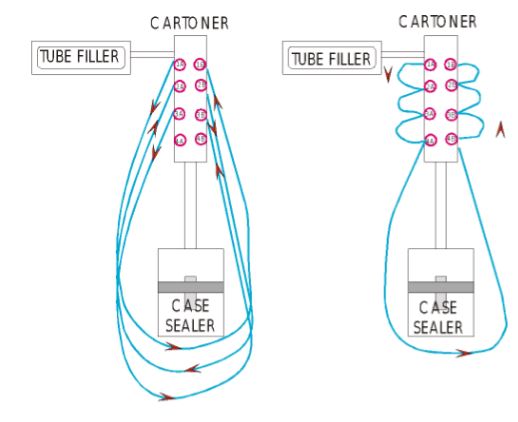
A few years ago I was working with a production team to improve changeover on a tube filling and cartoning line. The way they were adjusting the filler required walking around the end of the line several times as shown on the left:

Frain Image

During an observation of the changeover one of the operators timed the mechanic. We found that, in addition to the time spent making the adjustments, they spent 5 minutes walking.

A bit of brainstorming later, the team decided that all adjustments could be made on one side then on the other as shown on the right.

How much time is being lost in your plant just walking around unnecessarily? Charting this on a spaghetti diagram can be an interesting exercise. Then figure out how to eliminate and simplify movement.

Think of the money you’ll save on shoe leather!

Timing is Money

All spending must be expected to bring in more than goes out or there is no reason for doing it. Last month I talked about the simple payback method of cost-benefit analysis. Simplicity is both the strength and the weakness of payback. Payback assumes that cash flows, in and out, will be consistent. They seldom are. A project may require a big cash outlay at the beginning, to buy a line for example, followed by a smaller outflow the first years, due to introduction costs and low volume. Then, in subsequent years, positive cash flow is expected to increase as sales take off. Payback does not handle this situation well.

Another issue is the time value of money. A dollar today is worth more than a dollar a year from now. Terrific revenues 10 years from now may not offset negative or small revenue flows in the early years.

More sophisticated analysis must be applied to fine tune the project’s profitability. Two common methods are Net Present Value (NPV) and Internal Rate of Return (IRR). They are essentially the same except that in NPV the interest rate, more accurately the cost of capital, is a given and the analysis yields the net present value of the investment. IRR takes the cash in and outflows and solves for an interest rate. The main advantage of NPV over IRR used to be that it was easier to calculate. Now, spreadsheets like MS-Excel, make both simple. IRR has the advantage of giving a percentage rate of return that is easily compared to a company hurdle or to other potential investments. The choice is usually a matter of company policy.

Whichever method is used, good results depend on good data. All inflows and outflows must be identified as accurately as possible. This is usually the hardest part. Once that is done, it is basically just plug and play.

Time is money and so is timing. It is almost as important to financial decisions to know when cash will flow as it is to know how much.

My book, Secrets of Buying Packaging Machinery with John Henry is available on Amazon has much more information on project financial analysis. Call us 630-629-9900 and we’ll help you figure out your best options.