Tag: Uber

Fast Access

Machine speed and speed of getting a machine or lead time are two important considerations.

Numerous times a day we help customers calculate what machine speed they will need.

It’s a lesser question in the grand scheme to the customer, but we calculate the real speed needed so often we likely save the customer time and money in doing so within a quick phone call.

Equally or likely more important is how quickly you can get a machine.  A lightning-fast machine speed doesn’t help, if you can’t get the machine for setup and running your product by _____________________ (fill in the blank with date).

If you need to put out a fire, you need the extinguisher in your hand, right now.  Later, the best or cheapest of extinguishers will be useless.

Typically our customers want and need the machine yesterday. Our customers do not pay the price of waiting, which is integral to the service we offer.

We don’t just sell machines.  We sell access.  Fast access to machines and manpower that can quickly deliver machines and entire packaging lines working to the customer’s specification.


Capture


From the variety of inventory we store on site or within our four local buildings, we also sell the experience and capability to work on your project across hundreds of categories and manufacturers.

At the core of our team, you’ll find experienced engineers who’ve been in this growing space for a combined 150 years.

We get hundreds of calls a week and put people directly in touch with these engineers before they entertain which machine is best for their application.

In the end, our customers get access to machines and packaging lines via rental or leasing terms that are fully reconditioned, upgraded, and customized in order to seize marketplace opportunities and maximize their businesses revenue.

Our Customers Don’t Want Machines

Today, more and more people are tapping the Uber or Lyft app on their smartphones.  They’re not doing this because they want a car.  They’re doing it because they’re taking a trip – and need a vehicle to get from point A to point B.

Similarly, Frain customers don’t ultimately want a machine, even though some are amazing to watch during product cycling.  Instead, want to reach their business goals, their point B.  Our customers want to produce new or incremental revenue as quickly, reliably, and inexpensively as possible.

In September, Frain Integration hosted the Uber Revolution Packaging Summit, an event sponsored by the Contract Packaging Association.  One big take away from this event was that yesterday’s owned assets are being replaced by shared assets today. Keynote speaker, Ron Sasine of Hudson Windsor pointed out that, “Yesterday’s way of doing things seemed to work pretty well if you owned assets, but today’s market devalues asset ownership in favor of service providers.”

Endless variety and sense of urgency pushes for Uber-esque elements within today’s CPG supply chain.  For example, an Uber-style of packaging machinery supply will not only provide equipment when needed, as needed, for as long as it’s needed, it will:

  • reduce capital costs
  • decrease downtime
  • boost production
  • increase speed to market
  • supply services to facilitate success

Frain’s business model has evolved to match this approach.  Our ready-to-deploy inventory, which is the largest in North America, helps customers get to point B quickly and reliably.  We allow our customers to borrow (rent) and return individual machines or complete packaging lines as needed and re-deploy to the next customer tapping onto our site and requesting our help to get their business to its next destination.

Top 10 key takeaways from the Uber Revolution Pack Summit

Frain Integration, in partnership with the Contract Packaging Association (CPA) and other industry leaders, was proud to host the Uber Revolution Pack Summit – Tuesday, September 20 – 21, 2016.  Below are some testimonials from this summit, followed by key takeaways.

“Loved Ron’s presentation, and the supplier panel was also very good.”

“It was well done and I’m thankful to be invited.”

“This event was well thought out and presented.”

Here are ten important takeaways from this summit.

  1. Data

Jason Tham, CEO of Nulogy Corporation stated that, “It does not matter what you build. It is what you have access to.” Millennials, in particular, have immediate global communication research influence, and real-time data at their fingertips. This instant access to information, feedback, influence, but most importantly data – pushes agility, decisions, and market trends.

  1. Speed/Agility

According to Business Insider, 40% of millennial consumers turn to on-the-go breakfast options to minimize clean-up time. Having breakfast options when and where it’s needed is not only convenient, but often faster. Likewise, speed and agility are becoming top priorities within the supply chain.  Suppliers and brands are collaborating via shorter runs, data sharing, and speed to market incentives.

  1. Shared Assets

A shift is taking place whereas temporary, short-term assets are superior to fixed assets. Vacation rentals and taxi fleets, for instance, are not centrally provided in the shared model, but instead nimbly deployed as needed.   Shared manufacturing and access are also emerging and offering the same efficiency within the Packaging Industry today.

  1. Collaboration

Depending on the level of collaboration, brands must be flexible. They leverage each other’s data, logistic resources, and distribution centers. Still, brands have to consider how collaboration impacts intellectual property (IP). Geographically, certain cultures may make it difficult due to replication and speed, while suppliers may make it challenging due to knowledge access.

  1. Flavor Explosion

Keeping up with flavor explosion has proven to be a challenging opportunity for brands.  New demand aims for solutions where brands understand that selling existing products is not an alternative. Rather these temporary solutions are primarily driven by data, information, and agility. An interest in organic baby food, as an illustration, drew a need and preference that established a new price point for apple sauce.

  1. Packaging and Size Portion

Sustainability and health concerns have pushed for a less is more movement. Wasteful and non-recyclable packaging has transformed to new, smaller, and/or prudent packaging. Take for example, Libby’s Sweet Corn went from a 16 oz. can to a 14 oz. stand up pouch without changing the price- $1.19.

  1. Commerce

E-commerce has competed with traditional commerce for several years, but is it possible that retail shelf space will decline due to the on-line channel? Communication between brands, suppliers, and retailers is the essential to the off-line market while real time data is key to an online channel.    There is an extremely profitable future in e-commerce and many companies, like Clorox, are trending to this space, and investigating how to best supply product to this network.

  1. Technology

Todd Caraway, Director of Contract Manufacturing of Continental Mills, Inc. stated that, “Technology continuously increases in impact.” Mike Brodie, Director of Contract Manufacturing Partnerships of Torani agreed to, “Invest in data and make decisions upon that data.”

  1. Mass Individualization

Long gone is yesterday where uniformity and similarity was the mass customization of a group. Today individual needs are calibrated for a mass customization of an individual with an explosion of private label competition versus big brands.

  1. Transparency

Now, more than ever, consumers want to know what they are consuming and where it came from. The ultimate goal is complete product transparency and brands need to collide with the supply chain to achieve it. Through transparency companies create brand loyalty and establish differentiation among competitors.


Uber Speed Revolution

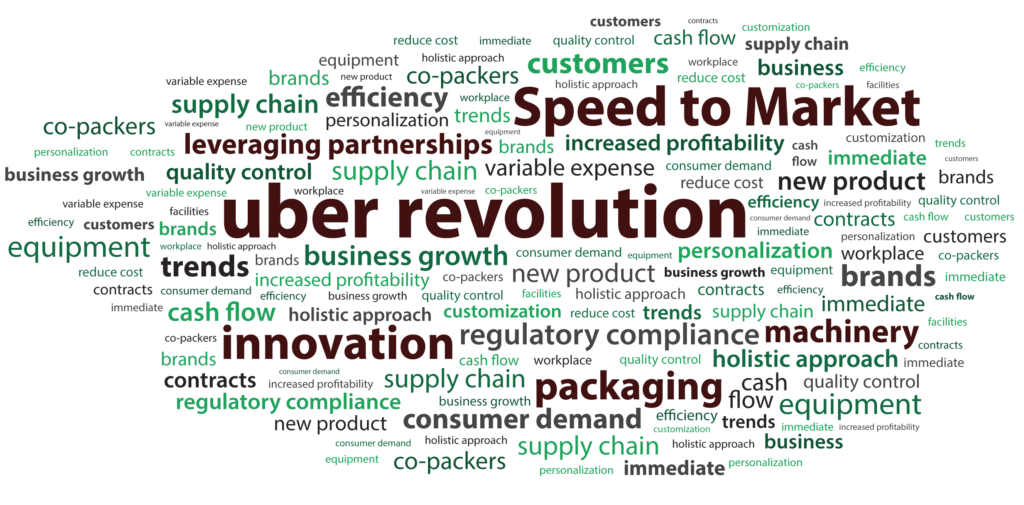
Uber-Revolution

Recently, Frain Integration spent over 500 hours of research time in interviewing 100 Brand Owners, CEOs and Plant Managers within the Packaging and Processing Industry.  Not surprisingly, most respondents ranked speed to market as their top priority.

Looking deeper into why speed to market is number one, research respondents specified that for every week late to market – 7% of brand category sales and 12-15% of margins are lost. With companies frequently launching new products, quickly finding out what is working and what’s not working is critical.

Traditional strategies- including direct OEM purchases, broker or third party purchases, used equipment dealers, or working with several companies- proved to be unsuccessful.  And even with what appears to be an excellent strategy, companies have repeatedly faced inconvenient turnaround times and problematic delays from trusted equipment suppliers.

Companies today need ultimate speed and convenience in being able to adjust to market demand, innovation, and finances.  In other words, they need disruptive, Uber-style strategy that enables them to “get cash sooner” and surpass competition. Frain Integration reacted to respondents concerns by introducing an approach that expedites new product launches, enabling customers to respond faster to market demand changes. Additionally, Frain customers can safeguard shelf space, and produce incremental-additional revenue faster.

Related Links:

Uberization: Maximizing Idle Assets

We are living in an era where technology and instant access is the norm, in particular to millennials.  With expectations and priorities set differently compared to other generations, businesses like Uber are providing services to accommodate these expectations.

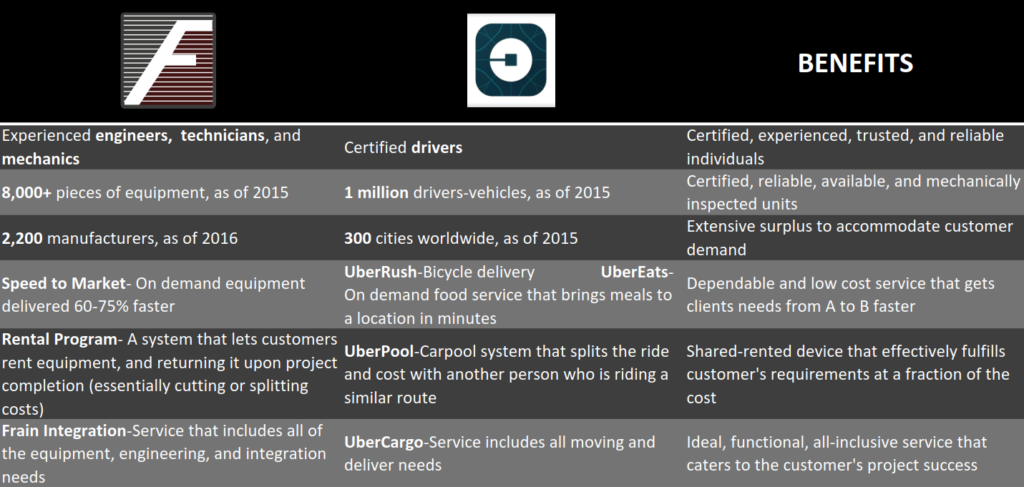
For those that are unfamiliar with Uber, it is a service where passengers are matched to nearby, certified drivers and mechanically-inspected vehicles ranging in sizes to accommodate passenger requirements. Uber provides individuals with reliable, instant access to what they want, when they want it, and for as long as they need it-transforming a former idle asset into a vital societal component.

Very similarly, Frain uniquely provides trusted, reliable, and accessible equipment assets:

  • Certified, pre-owned packaging and processing equipment
  • Within 6 weeks – typically taking 5x longer via OEMs
  • For rent and return at our customer’s convenience

70% of Frain customers say that response time is what they appreciate most about working with us:

“Response time on issues and questions was great!”

“The team is informative and makes every effort to meet our deadlines.”

Frain’s rental program gives clients an edge by providing single units, multiple machines, or complete lines without the need of ownership or expense. The Speed to Market strategy, as another illustration, cuts equipment lead time by 60-75%.

A glance at Frain’s Uber-like offering:

Uber Blog

Frain Integration is an extensive concept that was developed to facilitate our customers need to successfully integrate equipment. Unlike OEMs, Frain does not have loyalty to specific manufacturers giving our customers an advantage to integrate the equipment that best suits their application. It is the ideal solution for individuals that want an all-inclusive service when increasing production, partnering with contract packagers, partake in a new product roll out, and more.

A glimpse at Frain Integration’s functionality:

  • Complete integration of existing or certified pre-owned equipment
  • Several manufacturers available to correctly incorporate all of the units
  • Dedicated engineers and man power to target project requirements
  • May be combined with other Frain services for optimum results

Frain’s Uberization approach has responded to the growing influence of instant access by not only providing trusted and reliable services, but by maximizing and leveraging idle assets.


Resources
https://www.businessinsider.com/history-of-uber-and-its-rise-to-become-the-most-valuable-startup-in-the-world-2015-9
https://www.washingtonpost.com/news/dr-gridlock/wp/2015/06/04/uber-turns-5-reaches-1-million-drivers-and-300-cities-worldwide-now-what/