Tag: Technology

Connecting Islands of Automation

In John Henry’s white paper, Flat-Top Conveyor Basics, he explains that “conveyors are intelligent bridges between islands of automation.”

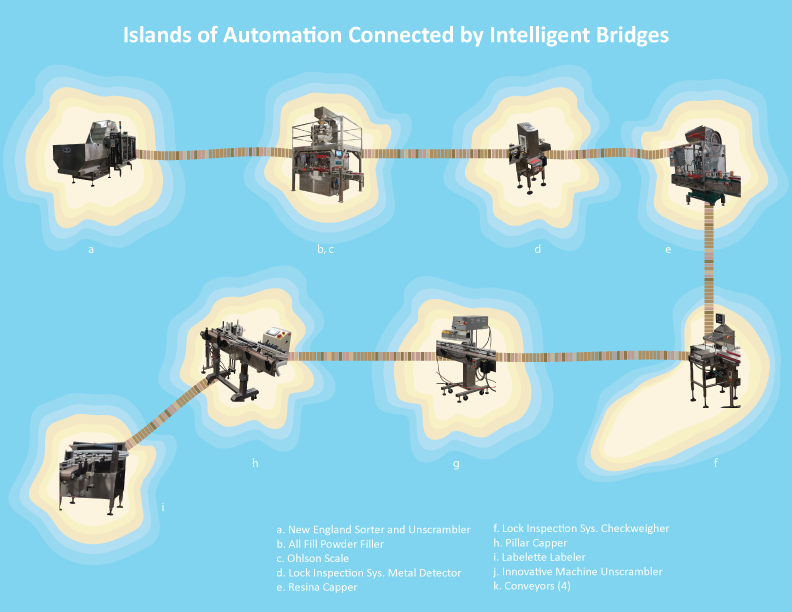
A complete, dry product filling line filling 16 ounces of peanuts at 20 bottles per minute is a great example.

Each automated machine is connected by different conveyors – 3 bottomless side belt and 1 table top –  that push the product to the next machine. When the product arrives at its final destination – an unscrambler – the product is ready to be boxed.

Would it be possible for these islands of automation to effectively generate the same product without conveyors? Maybe, but smart automation cannot occur without automated machinery or the bridges that connect them.

Islands-of-Automation-Meijer

Optimizing production relies on different variables, including equipment, technology, artificial intelligence, data, and more. It helps increase productivity, efficiency, quality, and safety while reducing the cost of labor and damaged material.

At Frain, we can quickly and effectively help you connect islands of automation to intelligent bridges.

Our team is available to help you enhance and automate your production application faster than anyone else.

Click here to learn more about the complete packaging line that is shown above.

Intelligent Automation

A highly-fantasized process, automation can be as simple as auto-updating computer programs or as complicated as a packaging system of automatic equipment. Though automation has highly reduced time and labor when properly implemented, intelligent automation will help adapt to new technologies and innovations.

In effect, the goal of a smart and automatic packaging line is to optimize the production using multiple variables including computer vision, robots, or other artificial intelligence/technology, thus intelligent automation.

Take for example, a manufacturing robot can be programmed to efficiently perform unique tasks in different industries and in one or more patterns. In the confection industry, a pick and place robot may be used to package chocolates in a container while the same pick and place robot may be used to handle/sort parts in the automotive industry.

Compiling and analyzing information is another equally important part of intelligent automation. Smart automation systems, for instance, collect data and use it to learn, adapt, and increase the efficiency of a process. Companies, such as Audi and Volvo, for instance, are using big data, including map grids, to introduce self-driven vehicles in the future.

Some individuals maintain that there is data that implies that consumers want less variation and more consistency when it comes to certain products. In fact, I recently read a consumer complaint on twitter that highlighted a discrepancy on the amount of frosting on a Pop Tart: “I’VE NEVER IN MY LIFE BEEN SO DISRESPECTED. @PopTarts411”. Another consumer described faulty brushes: “So I got new @kyliecosmetics lip glosses…. SO disappointed in this product. That wand is unacceptable”.

Both consumers brought up two great concerns: Why are the same items different from one another? What happened to quality control?

Solution to those questions can be provided with the use of intelligent automation of packaging and processing equipment. At Frain, we can help you automate intelligently – and quickly – by enhancing your production/packaging performance and efficiency while at the same time ensuring product quality.

Our trusted integration service, automation machinery, and project delivery speed sets our customers apart from their competitors.

Searching Made Easy

We’ve said it before: “Our success is directly attributed to the success of our clients.” [Chris Frain – Director of Inventory and IT Manager at Frain], and that is why we continue to strive for an invaluable website powered by an effective search engine.

This week, we launched a new site search engine that empowers our customers to find what they’re looking for faster and better than before.

Our search has been completely redesigned to feature clearer equipment results, sortable by every category and manufacturer within Frain’s inventory.

This new functionality extended to our customers supports our mission to provide the best and most knowledgeable resources to every customer from start to finish. Richard Frain – CEO and Founder of the Frain – agrees, “Knowledge and insight are what our customers want.” And Frain is always ready and able to provide instrumental knowledge, a willing team of engineers and technicians, and industry/equipment insight.

Click here to begin your search experience or click a button below.


TRY IT NOW        BROWSE INVENTORY

Big Relationships

While we fully support the fact that technology and data are exploding – we still favor big relationships over big data.

The Internet, Mobile Web, Uber, Amazon, Google, Facebook, etc. are all powerful forces leading the charge to amass data, disrupt every industry, and create new ones.

Frain, of course, embraces technology to upgrade our capabilities and communications with our customers.

But, to an even greater extent – we value people.

Today’s technology focus sometimes lacks or leaves behind the human element of meeting face to face, shaking hands, etc.

Frain bucks this trend by reaching out thru visits to our customer’s plants on a daily basis and inviting customers to visit us at Frain.

We’ve actually baked in-person visits into our process – namely the in-person factory acceptance test.

Some machinery and equipment sellers, renters will show you that the machine runs – the wheels go round and around.  For us, that’s not enough.

Not only do we fully restore each machine that ships and back it with parts warranty and our guarantee – We want you to personally visit us to sign off on your machine or complete line to your complete satisfaction.

We test each machine with your product samples before you visit and then invite you to see the same once we’re finished fine tuning each machine to your application.

To us, you’re more than a digit, data point, or piece of the pie chart – you are our number one focus and reason for our success.  You are Frain’s big relationship.

CPG Data Proliferation

I’ll be the first to admit that I often shop with my head in my phone – mostly because I shop with a list that’s already on my phone, but also because I can Google items if impulsively purchasing to see product reviews, or check various price offers for larger, non-impulsive purchases.

If shopping online, though, I’ll expect that this information already exists on the site to help with my purchasing decision.  That’s exactly what data companies in the CPG Industry are adding to internet retail, eCommerce, mobile marketplaces and real-time, omnichannel shopping destinations.

Forrester’s most recent eCommerce forecast estimates online retail sales to exceed $500 billion by 2020, up from $373 billion in 2016.

With real-time, shopping data pulled and pushed across the internet, the recycling of information in the CPG space is snowballing.

The CPG Industry has long relied on retrieving sales data directly from retailers like Walmart or indirectly thru syndicated market data providers like Nielsen.

As CPG companies begin to focus more on e-commerce and dealing with online retailers due to shifting consumer shopping trends, more and more data is beginning to fill this expanding pipeline.

New apps and companies are emerging to facilitate online and offline purchase data exchanges.  Data originates from receipt scanning apps like Receipt Hog or Ibotta and e-commerce services like Slice, where you can track all of your packages, purchases, price drops, and product recall info in one place.

ItemMaster, a spinoff of Peapod.com, recently struck a deal with Walmart.com to deliver certified brand content and IM content along with the shopping experiences for one of the largest eCommerce platforms in the World.

Apps and data services like this will not only help consumers to get a better handle on purchases but ultimately businesses to get a better handle on consumer demand and trends in real time.

Vision, People, Risk

Steve Jobs, co-founded Apple and was the visionary behind the Mac, I-Phone, I-Pad and other products. Jobs didn’t bring much in the way of tech skills to the table. What he did bring, and what made Apple such a successful company was vision, people and the willingness to take risks to validate them.

Steve Jobs was primarily an idea man. He envisioned the Mac, I-Phone etc. These seem pretty straightforward now. But until Jobs had the idea, “Hey, let’s make a phone that is smart enough to…” we were all happy with our dumb phones. We couldn’t even envision the next step. It’s why Jobs didn’t believe in market studies. Had Apple gone out and asked people what they thought of the idea of an I-Phone people would not have been able to even understand the question. The only way to bring something as revolutionary as the I-Phone to market is to bring it to market.

In order to do this, he had to have good people who could implement his vision. All sorts of people starting with Jonny Ives who designed the look and feel but also the engineers who developed the technology, programmers, manufacturing specialists and so on.

Either the visionary or the team, by themselves, are like one hand clapping. It just doesn’t happen.

The other thing Jobs needed to do was risk. He had a product that he was sure was going to be successful. What if nobody else shared his vision once they saw it? It ain’t cheap to bring a new product to market and the risks of failure are high.

Steve Jobs could have played it safe. He could have waited for someone else to build the first smartphone. Had he done that, the I-Phone would be just another smartphone instead of the iconic symbol it is today.

Got a great idea? Got a great team to help you implement it? You have to take the risk. It’s the only way humankind keeps moving forward. We can’t stand still. Work to manage the risk, but take it.

Goldie Oldies

Old doesn’t mean obsolete. Not in packaging machinery. We routinely rebuild machines from the 80’s, 70’s and earlier.

Manufacturing used to be much more stable than it is today. Technology and products evolved slowly. When someone bought a new capper or cartoner there was a good chance it would be running the same package and product 20 years later.

The classic example of this is Coca-Cola. For over 50 years there was only one “Coke” product. Coca-Cola in a 6oz returnable glass bottle. Since there was no need to run additional products, the line could be optimized to run this forever.

This meant heavy duty machinery made up of castings and forgings. It meant standardized designs where reliability and simplicity of operation and maintenance were key parameters. Flexibility? Why bother? The product would never change.

We can see this heritage in today’s machines. A Jones CMV cartoner, Resina capper or Cozzoli filler today looks and runs much the same as it did in the 50 years ago. The benefit in the plant is that after all these years and all these machines, they have been completely debugged. Whatever can go wrong has and has been fixed. The strong designs survived, the weak ones fell by the wayside.

There are some drawbacks to old machines. Safety guarding is one. Electrical and control systems are another. Fortunately, these drawbacks tend to be relatively minor in the grand scheme of things. Safety guarding is easily fabricated from 80/20 material and Lexan. PLCs are incredibly cheap and easy to program. At Frain, we usually don’t even mess with the old electronics. We find it simpler to just tear it out and start anew with PLCs, HMIs and other 21st century controls.

Flexibility can be built into the machine using quick change parts and the addition of scales, blocks and indicators for easy and precise setting.

Old doesn’t have to mean out of date. Many of these older machines are timeless and, with proper care and some periodic upgrades, will still be running when our grandchildren have retired.

That’s why they are called goldie oldies.

Whitepaper: Dry Filling

In previous papers I discussed liquid filling. This month I’ll talk about dry, or solids, filling. There are many types of dry products ranging from fine powders like talc or flour, to irregular pieces like frozen chicken parts. Other types of dry products include pharmaceutical powders, regular shaped products like nuts and bolts, candies and pharmaceutical tablets.

A variety of filling technologies are available. Many times more than one technology will give satisfactory results on a particular product/package combination. In most instances, there is one technology which will give the best results when all factors are considered.

Dry filling technologies can be broken down into 3 basic categories:

  • Volumetric filling dispenses a measured volume of product.
  • Weight filling dispenses a measured weight of product.
  • Piece filling dispenses a specific count of product.

Sometimes the package label claim will determine the technology to be used. Two popular candy mints are packed in similar containers. In the 90’s and prior, one of them claimed a certain weight of mints on the label. The other claimed a specific number of mints. To assure label claims were met, one had to be filled by count, the other by weight.

Download the complete Dry Filling Whitepaper to continue learning about dry or solid filling.

Top 10 key takeaways from the Uber Revolution Pack Summit

Frain Integration, in partnership with the Contract Packaging Association (CPA) and other industry leaders, was proud to host the Uber Revolution Pack Summit – Tuesday, September 20 – 21, 2016.  Below are some testimonials from this summit, followed by key takeaways.

“Loved Ron’s presentation, and the supplier panel was also very good.”

“It was well done and I’m thankful to be invited.”

“This event was well thought out and presented.”

Here are ten important takeaways from this summit.

  1. Data

Jason Tham, CEO of Nulogy Corporation stated that, “It does not matter what you build. It is what you have access to.” Millennials, in particular, have immediate global communication research influence, and real-time data at their fingertips. This instant access to information, feedback, influence, but most importantly data – pushes agility, decisions, and market trends.

  1. Speed/Agility

According to Business Insider, 40% of millennial consumers turn to on-the-go breakfast options to minimize clean-up time. Having breakfast options when and where it’s needed is not only convenient, but often faster. Likewise, speed and agility are becoming top priorities within the supply chain.  Suppliers and brands are collaborating via shorter runs, data sharing, and speed to market incentives.

  1. Shared Assets

A shift is taking place whereas temporary, short-term assets are superior to fixed assets. Vacation rentals and taxi fleets, for instance, are not centrally provided in the shared model, but instead nimbly deployed as needed.   Shared manufacturing and access are also emerging and offering the same efficiency within the Packaging Industry today.

  1. Collaboration

Depending on the level of collaboration, brands must be flexible. They leverage each other’s data, logistic resources, and distribution centers. Still, brands have to consider how collaboration impacts intellectual property (IP). Geographically, certain cultures may make it difficult due to replication and speed, while suppliers may make it challenging due to knowledge access.

  1. Flavor Explosion

Keeping up with flavor explosion has proven to be a challenging opportunity for brands.  New demand aims for solutions where brands understand that selling existing products is not an alternative. Rather these temporary solutions are primarily driven by data, information, and agility. An interest in organic baby food, as an illustration, drew a need and preference that established a new price point for apple sauce.

  1. Packaging and Size Portion

Sustainability and health concerns have pushed for a less is more movement. Wasteful and non-recyclable packaging has transformed to new, smaller, and/or prudent packaging. Take for example, Libby’s Sweet Corn went from a 16 oz. can to a 14 oz. stand up pouch without changing the price- $1.19.

  1. Commerce

E-commerce has competed with traditional commerce for several years, but is it possible that retail shelf space will decline due to the on-line channel? Communication between brands, suppliers, and retailers is the essential to the off-line market while real time data is key to an online channel.    There is an extremely profitable future in e-commerce and many companies, like Clorox, are trending to this space, and investigating how to best supply product to this network.

  1. Technology

Todd Caraway, Director of Contract Manufacturing of Continental Mills, Inc. stated that, “Technology continuously increases in impact.” Mike Brodie, Director of Contract Manufacturing Partnerships of Torani agreed to, “Invest in data and make decisions upon that data.”

  1. Mass Individualization

Long gone is yesterday where uniformity and similarity was the mass customization of a group. Today individual needs are calibrated for a mass customization of an individual with an explosion of private label competition versus big brands.

  1. Transparency

Now, more than ever, consumers want to know what they are consuming and where it came from. The ultimate goal is complete product transparency and brands need to collide with the supply chain to achieve it. Through transparency companies create brand loyalty and establish differentiation among competitors.

3D Printing and Scanning

I saw my first 3D printer at an H-P plant in 2001. They had printed a fully articulated V8 engine in about 1/4 scale. It was love at first sight. Theirs cost about a quarter million dollars then but today’s systems are much more capable and much cheaper. Fairly good, if basic, systems can be had for under $1,000.

One of the problems with 3D printing is that it requires a 3D drawing. This can take some of skill and time to produce. For a complex geometry getting the dimensions right can be close to impossible. Wrong dimensions make a useless part.

I was watching some YouTube videos of how Jay Leno uses scanning and printing in his garage to restore 100 year old cars. When he has a broken part he scans it with a FaroArm www.faro.com This gives him a drawing, accurate to an incredible 0.0009” that he can tweak in AutoCad if needed. Then into what he calls his “magic oven” (the printer) and a few hours later he has an exact part in plastic.

After checking for fit on the car, he sends the drawing to a machine shop to CNC the real part out of metal.

Image1

What a concept for a plant maintenance shop!

How often is a machine down for days for want of a simple part? It may be a custom piece that the machine builder does not stock so you have to wait for them to make one. If it has to come from Europe it may be weeks or even months. Some maintenance shops have wizard machinists who, given a Bridgeport and a lathe, can make anything from scratch. Those folks are getting harder and harder to find and even if they can do it, it takes time.

You think nothing of spending $10-$20,000 for a machine tool for the shop. How about drop a few bucks for a 3D printer and scanner? Compared to the cost of downtime, the ability to get back up and running in hours instead of days is peanuts.

If you don’t have a scanner and printer already, buy one. If nothing else, you need to find out what it can do.

The two Jay Leno’s Garage episodes are here:

https://www.youtube.com/watch?v=q3SVTBrKyZk

https://www.youtube.com/watch?v=7ZrJsrTT4EA