Tag: automation

Robots and Automation

It seems like I can’t turn around these days without seeing another article about robots. Especially about how robots will be taking over all jobs in a few years. But it also seems like robots and automation are getting confused in the public eye. There’s a lot more to automation than robots.

At Frain we know robots. We work with them every day. With more than 8,000 automated machines in stock, we also know about automation.

Robots are great for a lot of things. They are particularly useful when flexibility is required. Since they are standardized, they can be built in quantity, making them less and less expensive.  There are a lot of packaging applications for robots.

There are also some downsides. Speed is one. Try to find a robot that can cap bottles at 400ppm. Complexity is another. They need programming which is something of a specialized skill. Some companies and some geographic locations do not have access to these skills. A robot intended for general use may never be as good as a machine purpose-built for a specific use.

Robots can take up considerable space. The robot itself may be compact and may actually only work in a limited area. Moving cartons from the line to a case, for example. Guarding must be provided for all possible areas where the robot could reach.

Note the amount of unused area relative to the working area in the picture below. A dedicated automatic machine with the same function might occupy 20-30% of that space.
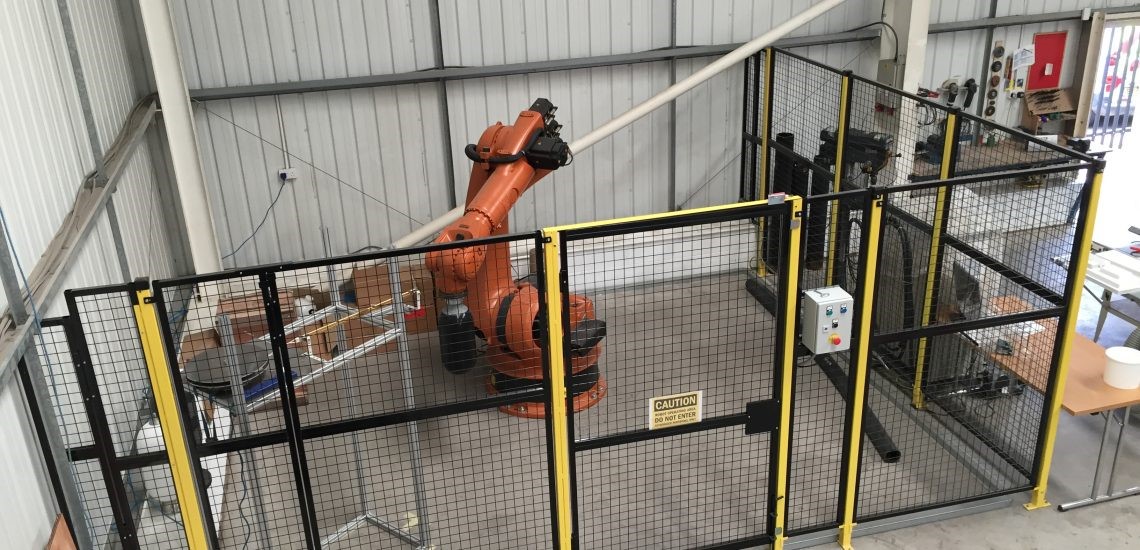
Image 1

Dedicated automatic machinery my not be as versatile as a robot but it will probably be better at what it does. It will certainly, in many instances, be faster. Lines running 1200 bottles a minute are no problem for standard fillers, cappers, labelers etc. but no robot could ever keep up.

I’ve been hearing how automation was going to take all jobs since I was a kid. I’ve been hearing how robots were going to take all jobs since the 70’s. What we are hearing today is nothing new and nothing bad.

Automation, whether by purpose designed machines or flexible robots means more efficiency and that’s good for everyone.
Business Is Good

Aside from automating or replacing manual, old, tired practices within processing and packaging – our customers usually are contacting us because business is good.

By good, I mean growing, expanding, branching out into new products or packaging.

Our customers are expanding, quoting new business, can’t get machinery and equipment fast enough for a new or expanded project.

They’ve discovered the next best flavor or a byproduct of that they can now monetize to further increase revenue.

Regardless of growth origin or impetus for purchasing new machinery, our customers are often so excited that we just have to slow them down in talking to ensure we have the whole story.

They’re often in a hurry for a price for which they can get approval or use to shop and we certainly understand that.

We realize it’s well worth everyone’s time at this point to ask all the questions – how are you doing to today, what speeds, what’s the specific application, how long will you need it, etc.

We then match the machine and put man hours toward the machinery – mechanically, electrically, cosmetically, and pneumatically.

Our resources hit the project simultaneously – we have all the necessary parts, machines, and manpower to get you quality and complete lines fast.

We, of course, embrace the growth of our customers business and simply ask them for the time to discuss and ensure we do it right for them the first time.

This includes planning for the unknown.  We’ve recently primarily focused on providing new and like new machinery for rent.

We have what our customers want, when they need it, how they need it (customized by our engineering and tech team), for as long as they need it.

They return the equipment to us after their finished using it (if ever) – no questions asked.

Ultimately, we’re a resource to our customers – especially when they need to grow now and with reliable packaging and processing equipment solutions.

Equipment Automation: Efficiency

What is the source of your plant inefficiency? Does it come from lack of training, damaged product, minimum/slow production, machine set-backs, material costs, or labor?

All the above has the potential to negatively impact your efficiency resulting in minimal production and profit.  The best and fastest way to improve efficiency is by automating an existing process.

An automatic application can usually at least double the output of any given process. Automatic packaging or processing machinery typically requires no operator, little to no supervision, and can run 24-hours per day with proper maintenance.

It’s fair to note that efficiency goes hand in hand with production and the goal is to achieve maximum output with minimum expense.

Many companies and individuals interested in automating their process fail at justifying the cost of automation. Corporations weigh out their options, but occasionally miss a few angles that include leveraging the cost of operators, benefit packages, production, efficiency, and more.

Shedding light on these hidden costs can easily justify rapid automation.  If the cost of your efficiency is weighing you or your company down, then it’s time to address the issue.

With the help of Frain, you can be as efficient as you are meant to be.  We offer the largest packaging and processing equipment inventory, accommodating rental and leasing options, and the quickest delivery in the industry.

Equipment Automation: Productivity

Manual and semi-manual production rely highly on their employees and operators. This, over time, leads to product inconsistencies, damage, and ultimately decreased production. Not to mention a boost in material costs.

Individuals become tired, slow down, and have a shorter attention span as an eight or ten-hour shift progresses. The product and/or product packaging are now at risk of becoming inconsistent or damaged.

Moreover, people cannot compare to machines when it comes to speed. Depending on the application, individuals can safely and accurately produce up to 1/4 of product – on average – compared to an automatic machine.

For example, Frain took a customer from a manual process that on average produced 5 complete bottles of product per minute to 20. In a 50-minute 10-hour shift, the company produced 2,500 bottles manually while the Frain automatic application yielded 10,000…four times as much production and revenue.

The bottom line is that automated packaging produce more than manual labor/operators and ultimately cut down costs while increasing productivity.  In fact, it’s better to couple your best people with machinery for getting the job done more efficiently.

A wide selection of automatic packaging and processing equipment with flexible rental and leasing options is the first step in easily automating your application and maximizing profit.

Connecting Islands of Automation

In John Henry’s white paper, Flat-Top Conveyor Basics, he explains that “conveyors are intelligent bridges between islands of automation.”

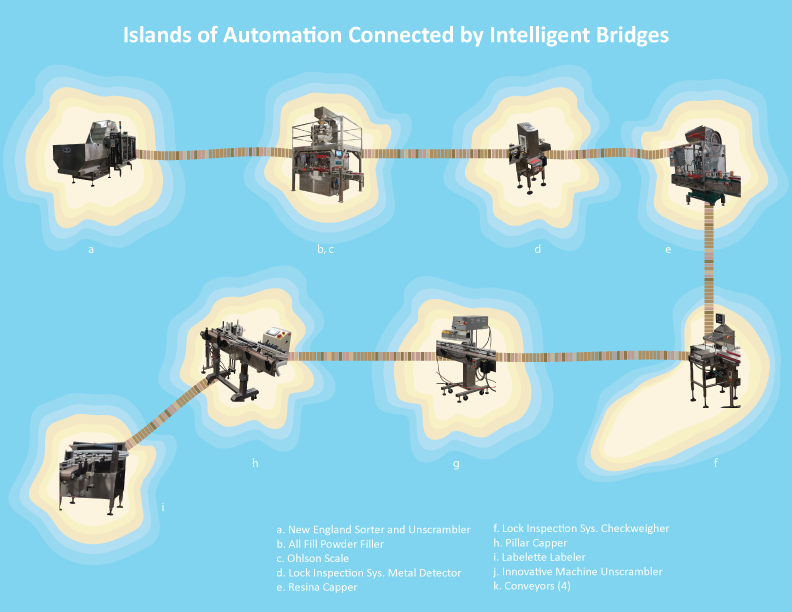
A complete, dry product filling line filling 16 ounces of peanuts at 20 bottles per minute is a great example.

Each automated machine is connected by different conveyors – 3 bottomless side belt and 1 table top –  that push the product to the next machine. When the product arrives at its final destination – an unscrambler – the product is ready to be boxed.

Would it be possible for these islands of automation to effectively generate the same product without conveyors? Maybe, but smart automation cannot occur without automated machinery or the bridges that connect them.

Islands-of-Automation-Meijer

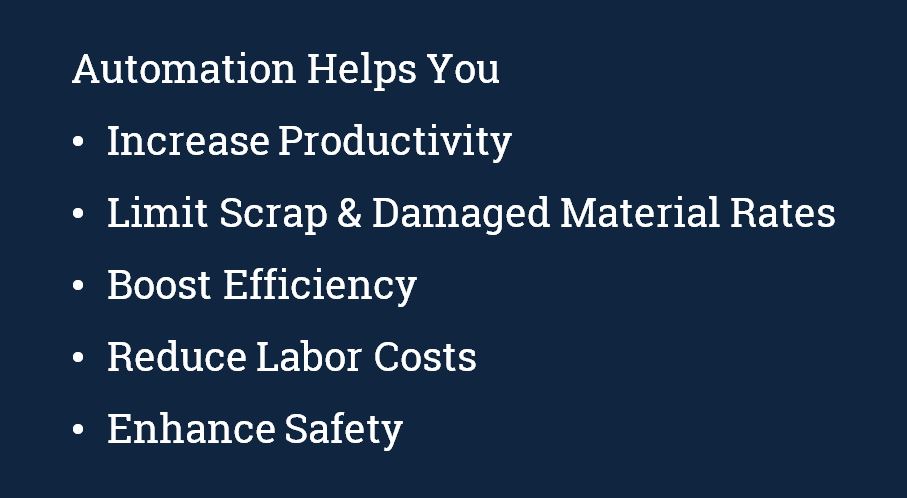
Optimizing production relies on different variables, including equipment, technology, artificial intelligence, data, and more. It helps increase productivity, efficiency, quality, and safety while reducing the cost of labor and damaged material.

At Frain, we can quickly and effectively help you connect islands of automation to intelligent bridges.

Our team is available to help you enhance and automate your production application faster than anyone else.

Click here to learn more about the complete packaging line that is shown above.

Human Touch

Today, some technology and websites make money all on their own.

You can browse inventory online, purchase items, and perhaps even get delivery via drone.  All with very little human interaction, your needs are met.

What we offer is extremely different. In fact, it’s very human. You might even say we don’t even sell machines… well at least not on their own for the most part.

Some may say I just need a price (on a machine).

Or I need to know how old it (the machine) is.

A robot or website could provide you with this information – It’s meaningless to what we provide.

We don’t provide much that’s not humanly or better yet expertly vetted and configured on your behalf.

From the people you talk to initially to the people who ultimately configure the machinery to run your specific application, there are many humans involved on the Frain side.

People will call and ask to speak with a sales person.  We instead put you immediately in touch with an engineer.

What good is a sales person if he’s selling you the wrong machine?

You can buy machinery online without talking to anyone and that could very well be the right solution for you.  Or not.

We offer a different option.

We offer an option of adding expertise and experience to quality machinery and the service of customizing it to your needs fast.

We rebuild, refine, recalibrate, and customize the machinery to meet your specific needs while bringing it up to date as certified pre-owned.

Our certified machinery goes through a meticulous inspection, is reconditioned to certification standards, and is backed by our warranty.

The machinery ships today as a 2017 customized and completely flipped machine or complete line.

Customers tap our engineers for the combined experience of over 100 years in the packaging and processing industry.

They tap our team of technicians who are equally experience and capable across all packaging and processing machinery categories.

They tap our inventory of thousands of machines, including complete lines.

All in all, you need more than simple answers to simple questions. You need experience and experts from the people at Frain who can quickly customize our inventory of steel to meet your needs.

The Social Push

With a tremendous rise in social media, companies, sectors, groups, individuals, etc. have been “exposed”.  Customers are not only expressing their likes/dislikes to the manufacturer. They are using public displays and online interaction to express concern, dejection, amazement or favoritism toward a brand, product, person and everything in between.

For example, a loyal customer shared her disgust of a cosmetic product over social media and even directly to the founder of the company: “So,,, I hit pan on my @JeffreeStar highlight and found HAIR embedded into it.” Another shared disbelief and difficulty supporting a product: “Your beef is frozen and we all know it. Y’all know we laugh at your slogan ‘fresh, never frozen’ right? Like you’re really a joke.”

As a result to public complaints, many companies have directly pushed for transparency and optimization of quality to improve their products.

Some companies turned to Frain for the automation of their production lines by using robots, detection technology or equipment that decreased the number of operators to reduce human error. Customers selected from a wide variety of packaging and processing equipment to convert to a semi-automatic or automatic process to enrich production lines and quality control.

Whether you prefer data collection/analyzation or a combination of both automation and data, Frain has the equipment needed for a seamless transition. Our technicians, mechanics, and engineers are dedicated to your equipment goals and integration requirements.

Let Frain help you like it has helped other companies.

From Floppy to Clouds

I recall going to computer class and inserting two floppy disks: one to boot the computer and another to play a game. At that time, patience was key because loading took about 5-10 minutes…nothing compared to the current 30-60 second loading time.

Floppy disks were revolutionary from the 70’s to 90’s and were considered an inexpensive “high-speed mass storage” apparatus, but were ‘read-only’ when first introduced. As time passed, floppy disks got smaller and transitioned to ‘read-write’ disks while becoming more budget friendly and doubling in capacity.

The push for even more convenient data storage surged and floppy disks began to fade out. Technology giants introduced superior data storage tools, like USB flash drives, external hard drives, and memory cards. The face of social media and a ‘share’ generation may have enabled cloud storage to hold massive amounts of media and data files available from any device upon login.

At their peak, floppy disks were high-tech, but technology advancement left them in a distant past. In a similar manner, automatic machinery is changing the way manual processes are perceived.

The industrial revolutions, for instance, took hand-crafted products to machine generated commodities that reduced time and labor and revolutionized American living with innovations like the lightbulb.

As in the past, innovation and consumer demand continue to spark mass production and thus, companies convert manual or semi-automatic practices to automatic methods as business takes off.

Companies looking to increase production/output requirements, new product roll out, open a plant and more come to Frain for semi-automatic, automatic, or integration requirements. Frain’s vast packaging and processing inventory has the equipment to get customers to market faster than anyone else in the industry.

The packaging and processing industries have primarily gone from manual to automatic like storage went from floppy to cloud, and although disks are still being used today in different industries like embroidery and aviation, there is a limited supply and companies will be forced to transition to newer technology.

Stay ahead of the game. Increase capacity, facilitate quality control and improve efficiency with semi-automatic or automatic equipment provided rapidly and conveniently.


Resources:
https://www.digitaltrends.com/computing/why-do-floppy-disks-still-exist-the-world-isnt-ready-to-move-on/
https://www.loc.gov/teachers/classroommaterials/primarysourcesets/industrial-revolution/pdf/teacher_guide.pdf

Intelligent Automation

A highly-fantasized process, automation can be as simple as auto-updating computer programs or as complicated as a packaging system of automatic equipment. Though automation has highly reduced time and labor when properly implemented, intelligent automation will help adapt to new technologies and innovations.

In effect, the goal of a smart and automatic packaging line is to optimize the production using multiple variables including computer vision, robots, or other artificial intelligence/technology, thus intelligent automation.

Take for example, a manufacturing robot can be programmed to efficiently perform unique tasks in different industries and in one or more patterns. In the confection industry, a pick and place robot may be used to package chocolates in a container while the same pick and place robot may be used to handle/sort parts in the automotive industry.

Compiling and analyzing information is another equally important part of intelligent automation. Smart automation systems, for instance, collect data and use it to learn, adapt, and increase the efficiency of a process. Companies, such as Audi and Volvo, for instance, are using big data, including map grids, to introduce self-driven vehicles in the future.

Some individuals maintain that there is data that implies that consumers want less variation and more consistency when it comes to certain products. In fact, I recently read a consumer complaint on twitter that highlighted a discrepancy on the amount of frosting on a Pop Tart: “I’VE NEVER IN MY LIFE BEEN SO DISRESPECTED. @PopTarts411”. Another consumer described faulty brushes: “So I got new @kyliecosmetics lip glosses…. SO disappointed in this product. That wand is unacceptable”.

Both consumers brought up two great concerns: Why are the same items different from one another? What happened to quality control?

Solution to those questions can be provided with the use of intelligent automation of packaging and processing equipment. At Frain, we can help you automate intelligently – and quickly – by enhancing your production/packaging performance and efficiency while at the same time ensuring product quality.

Our trusted integration service, automation machinery, and project delivery speed sets our customers apart from their competitors.

Make Magic Happen with Machinery

It’s a phrase that’s been uttered a million times from one person to the next:

I Bet You Can’t Do That Again

Usually, it comes after something so amazing and inimitable has been accomplished that we assume it cannot be repeated by any human being.

Being repeatably and reliably amazing is an unusual quality of humans.

When someone accomplishes a close likeness to repeatably amazing, we’re likely packing stadiums or at least paying to watch these individuals work their magic.

After all, we’re humans, not machines.  To err is human.

The machine offers a consistency of quality desired, even for artists.

As evidence by “the telephone game” even passing a simple message across several people multiplies the variations of error.

The quality and consistency of our daily motions vary tremendously.

Quality is best defined as “Absence of Variation”, that is, the first piece, the last piece, and all pieces in between are exactly the same.

Machinery helps us dial into and maintain consistency, quality, and absence of variation.

With machinery, you can bet on making your magic happen again and again, consistently.


Automate for Quality

People wreck your quality.

Not on purpose. Most people try very hard not to wreck quality and generally do pretty well. Still…

Quality is best defined as “Absence of Variation”, that is, the first piece, the last piece, and all pieces in between are exactly the same. In our real world, exactly never happens, of course, but it always needs to be the goal.

People, no matter how hard we try, can never do something exactly the same twice in a row. Multiple people multiply the variation. We’ll always be slightly different.

People are also notoriously dirty. Again, most people practice good hygiene and try their best to be clean. The reality is that we are big bags of germs. Even a scrupulously healthy and clean person can contaminate with a sneeze or a touch.

We hear “handmade”, “artisanal” and other terms bandied about as desirable attributes. They are, in some cases. We probably don’t want to pay a lot of money for an artwork that is exactly the same as 1,000 others. We want ours to be unique. Those are the exceptions.

When I see handmade, I generally see it as a negative. I want machine made. I want quality. I want it to be the same as last time. I don’t want not quite, I want exactly.

The only way to do this is with automation.

A well designed and properly maintained machine, will do everything the same way every cycle. The first, last and in-between products will be the same. Machines do get out of adjustment but they usually do it in a predictable way and can be brought back to setpoint. Materials and components can vary but this too can be addressed.

Automation does require investment. It used to be that if the production wasn’t needed, the investment sat there with no return. Rental machinery from Frain has eliminated that issue. It’s as easy as Uber.

Automate or get run over. It makes your product better and your people more productive.

Intelligent Bridges to Islands of Automation

In his latest white paper, Flat-Top Conveyor Basics, John Henry of Changeover Wizard states that “a series of machines such as a filler, a capper, a labeler and so on” are islands of automation.

Each machine, or automation island, can accomplish little on its own.  However, as comprehensive, line units or gestalts connected via conveyors, automated packaging lines produce more than the sum of their parts.

automation-helps-saftey-efficiencey-costs-productionre

John explains that “Too often conveyors are treated as the proverbial rented mule of packaging lines.”

Conveyors often bridge processes requiring some intelligence to take the product and feed it to the next machine and are therefore intelligent bridges.

Packaging engineers, plant, and operation managers often take conveyors for granted.  They are usually the last piece of equipment obtained by any project.

Ironically, conveyors are highly sought after in the packaging industry.  They are a diverse group that can be tailored to most applications. At Frain, we have over 10 kinds of intelligent bridges ranging from belts, bucket elevators, screw, infeed, vibratory, and more conveyors.

We also have the islands of automation from popular categories like capping, cartoner, candy, mixers, fillers, form fill seal, and more packaging and processing machines.

Download the complete Flat-Top Conveyor Basics white paper to continue learning about intelligent bridges.